Friday, August 27, 2010

SharePoint 2010 My Tasks Web Part using Search Driven Cross-Site Query with Muenchian Grouping

There always seems to be a requirement for rolling up data from all sites in one or more SharePoint solutions, such as getting a list of my tasks, a list of new documents this week, or creating a searchable news archive for publishing sites; or such as creating a site map or dynamic site directory based on metadata collected in your site provisioning workflow, that are later maintained by site owners.

SharePoint has several web-parts that can do cross-list and cross-subsite queries, such as the Content Query web-part, but all restricted to a single site-collection. In addition, there are the classic Data View web-part and the new XSLT List View web-parts that can be configured using SharePoint Designer. These web-parts can connect to a diverse set of data sources, from internal SharePoint lists to external REST and OData services.

Still, the simplest solution for cross-site/cross-solution rollups is to customize the ootb search web-parts against custom search scopes in the Search Service application. In most cases, no coding will be required, pure configuration of SharePoint will go a long way. This post will show how to configure a search driven "My Tasks" web-part that will show all tasks assigned to the user across all SharePoint sites across all indexed SharePoint solutions. The unstyled cross-site task rollup web-part looks like this, included some debug info:


First you need to configure the results scope behind the search driven web-part in Central Admin. Start by adding a new scope in 'Search Service Application>Scopes' called TaskRollup using the rules as shown here:


If you can't see ContentType when adding a rule, then go to 'Search Service Application>Metadata Properties' and edit the managed property to set Allow this property to be used in scopes.

As the TaskStatus site column is not mapped to any managed property by default, you must map the crawled property ows_Status to one before it can be used. Go to 'Search Service Application>Metadata Properties' and create a managed property called TaskStatus using the mapping as shown here:


Do not go creative with the naming, stay away from spaces and special characters such as ÆØÅ - a SharePoint best practice for any artifact name used as an identifier or an URL fragment. For example, a name like "Contoso Web Ingress" first gets encoded as "Contoso_x0020_Web_x0020_Ingress" when stored, and then once more encoded as "Contoso_x005F_x0020_Web_x005F_x0020_Ingress" in a search result XML.

A full crawl is required after adding or changing crawled or managed properties. Do a full crawl of the content source you used in the TaskRollup scope. Note that there must be some matching content stored in SharePoint for these properties to be added to the property database in the first place. Thus after provisioning new site content types or site columns, you must add some sample content and then do a full recrawl of the applicable content source.

Verifying that the full crawl of the SharePoint sites content source finished without errors completes the Central Admin configuration. Now it's time to configure the ootb Search Core Results web-part to become the customized My Tasks web-part.

Open a team-site and add the Search Core Results web-part to a page. Switch to page edit mode and select 'Edit Web Part' to open the Search Core Results settings panel. Rename the web-part 'Title' to Task Rollup (cross-site) and set the 'Cross Web-Part Query ID' to User query and 'Fixed Keyword Query' to scope: "TaskRollup" as shown here:


The Search Core Results web-part requires a user query, or a configured fixed or appended query, to actually perform a search. No configured or no user query will just show a message asking for query input. The cross-page query ID setting User query is chosen here for reasons explained later.

If you want to further limit what tasks are shown in the My Tasks web-part, just add more query keywords to the 'Append Text to Query' setting as shown here:


The My Tasks web-part will show the two task fields 'Status' and 'Assigned to' in the task list. Any managed crawled property can be added to the search results by configuring the 'Fetched Properties' setting. Add the following XML <Column Name="AssignedTo"/> <Column Name="TaskStatus"/> as shown here:


You need to uncheck the 'Use Location Visualization' setting to enable the controls for customizing the result set and XSL formatting. See A quick guide to CoreResultsWebPart configuration changes in SharePoint 2010 by Corey Roth to learn more about the new search location concept in SharePoint 2010. Read all his Enterprise Search posts for an excellent introduction to the improved SharePoint 2010 search services and web-parts.

After adding 'TaskStatus' and 'AssignedTo' to the fetched properties, you will also need to customize the XSL used to format and show the search results to also include your extra task fields. Click the 'XSL Editor' button in the 'Display Properties' section of the web-part settings panel, and add the fields to the match="Result" xsl:template according to your design. Note that the property names must be entered in lower case in the XSL.

The astute reader will have noticed the nice grouping of the search results. This is done using the Muenchian method as SharePoint 2010 still uses XLST 1.0, thus no simple XSLT 2.0 xsl:for-each-group. The customized "My Tasks" results XSL creates a key called 'tasks-by-status' that selects 'Result' elements and groups them on the 'taskstatus' field as shown here:
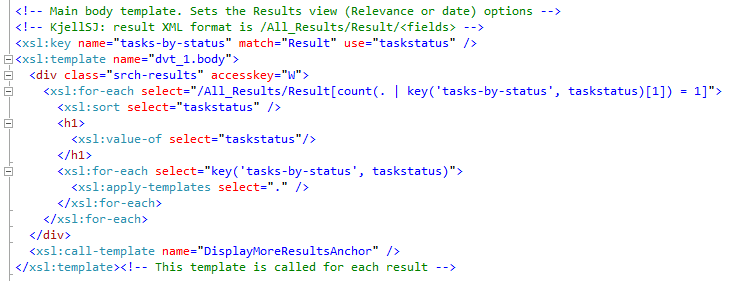

Again, note the requirement for lower case names for the fetched properties when used in the XSL. Use the <xmp> trick to see the actual result XML.

The final part of the puzzle is how to turn the cross-site task list into a personal task list. Unfortunately, the [Me] and [Today] filter tokens cannot be used in the enterprise search query syntax, so some coding is required to add such dynamic filter tokens. Export the customized Search Core Results web-part to disk to start packaging into a WSP solution.

Create a new TaskRollupWebPart web-part SPI in your web-parts feature in Visual Studio 2010. Make the new web-part class inherit from CoreResultsWebPart in the Microsoft.Office.Server.Search assembly. Override the methods shown here to add dynamic filtering of the query through the SharedQueryManager for the web-part page:

namespace PuzzlepartTaskRollup.WebParts
{
[ToolboxItemAttribute(false)]
public class TaskRollupWebPart : 
Microsoft.Office.Server.Search.WebControls.CoreResultsWebPart
{
QueryManager _queryManager;
protected override void OnInit(EventArgs e) {
  base.OnInit(e);
  _queryManager = SharedQueryManager.GetInstance(this.Page).QueryManager;
}
 
protected override System.Xml.XPath.XPathNavigator GetXPathNavigator(string viewPath)
{
  SPUser user = SPContext.Current.Web.CurrentUser;
  _queryManager.UserQuery = string.Format("scope:\"TaskRollup\" AssignedTo:\"{0}\""
user.Name);
  return base.GetXPathNavigator(viewPath);
}
 
protected override void CreateChildControls()
{
  base.CreateChildControls();
  //debug info
  //Controls.Add(new Label { Text = string.Format("FixedQuery: {0}<br/>
AppendedQuery: {1}<br/>UserQuery: {2}", 
FixedQuery, AppendedQuery, _queryManager.UserQuery) });
}
}
}

The code in GetXPathNavigator is what adds the current user to the QueryManager.UserQuery to filter tasks based on the assigned user by [me]. There are five query objects available on a search web-part page, where QueryId.Query1 is the default. This is also what is exposed in the web-part settings as the 'User Query' option. Use the GetInstance(Page, QueryId) overload in SharedQueryManager to get at a specific cross-page query object.

Replace the content of the TaskRollupWebPart.webpart file with the exported Search Core Results configuration. This will ensure that all the configuration done to customize the ootb web-part into the My Tasks web-part is applied to the new TaskRollupWebPart. A small change is needed in the metadata type element to load the new TaskRollupWebPart code rather than the CoreResultsWebPart code:

<webParts>
<webPart xmlns="http://schemas.microsoft.com/WebPart/v3">
<metaData>
<type name="PuzzlepartTaskRollup.WebParts.TaskRollupWebPart, 
$SharePoint.Project.AssemblyFullName$" />
<importErrorMessage>$Resources:core,ImportErrorMessage;</importErrorMessage>
</metaData>

Build the feature and deploy the package to your test site from Visual Studio 2010. Add the web-part to a page and verify that you get only your tasks as expected.

I know that this seems like a lot of work, but a search-driven web-part is easily created and tested before lunch. The inevitable styling & layout using XSL and CSS is what will burn hours, as usual.
 
A drawback of search driven web-parts or code is the delay before new/updated content is shown due to the periodical crawling schedule, typically five or ten minutes. On the positive side, the results will be automatically security trimmed for you based on the logged on user - no authentication hassles or stored username password required as with the XSL List View.

Note that most enterprise search classes are still sealed in SharePoint 2010 as in SharePoint 2007, except the CoreResultsWebPart and some new classes, so you're limited to what customizations can be achieved with configuration or the SharedQueryManager. Search driven web-parts works equally well in SharePoint 2007, except that there is no SharedQueryManager, but rather the infamous search results hidden object (SRHO) which is unsupported.

Recommended: SharePoint Search XSL Samples and the Search Community Toolkit at CodePlex.

Wednesday, August 04, 2010

Five Steps to Structure Your SharePoint Sites (Part III)

At every SharePoint customer and in every SharePoint project, the issue of how to realize a future-proof, working site structure arise. I've written a few blog posts on classification and structuring of SharePoint sites before (part 1 and part 2), focusing on scalable site structure design within the SharePoint system boundaries. This post is about getting from a classic site map based approach to a methodology driven by Information Architecture and the site classification pyramid, combined with the SharePoint containment hierarchy and SharePoint governance best practices. The latter is important as the management and usage of a site, and the service level agreement for the site, strongly influence how the overall SharePoint solution should be partitioned to adhere to architecture best practices.

Most information architects come up with a content organization model like a site map with hierarchical URL scheme. "This is the draft model, and we want the URL structure to be like this in our SharePoint solution" they say. "That's a very useful mental model of the site" I respond, "but what you really want is a good, intuitive navigation concept, helping users find what they need - like an invisible guiding hand; not that specific URL structure". Having a simple and easy mental model for the site structure is important, as it makes it easy to both contribute and find content, driving findability when the amount of information stored and managed in SharePoint grows.

Alas, that is not the primary issue with the site map approach for designing SharePoint site structures. The site map is closer to define statical IA structure than navigation, still it is only good for logical IA structure and cannot be expected to be used directly as the physical IA structure in SharePoint.


Using a site map approach to design a SharePoint site structure will only work in simple scenarios with homogenous solution domains, such as a publishing portal or a collaboration solution with limited document storage and versioning. It will fail when the SharePoint solution domains and their usage, governance and service level agreements differ, not to forget when the overall amount of data stored in SharePoint surpasses the 100GB limit per content database. The wanted URL structure might not be possible to realize in most cases anyhow when adhering to SharePoint architecture best practices.


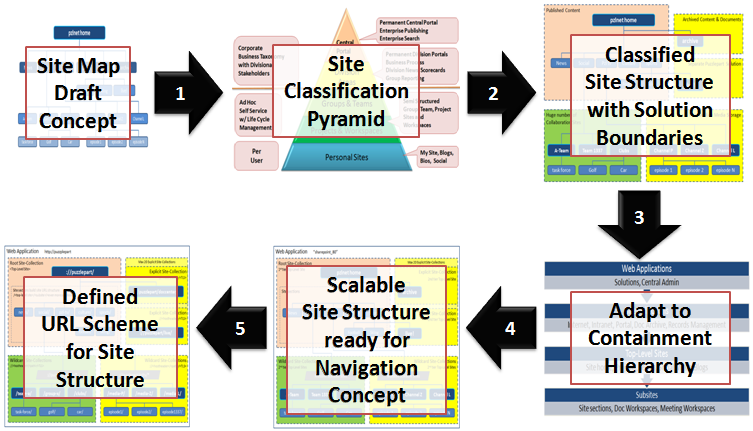
A more structured approach is needed to design a SharePoint site structure according to architectural and governance best practices. My methodology involves a process with these five steps:

  1. Review your site map draft model against the SharePoint site classification pyramid and your governance plan for each of your identified site types.
  2. Partition your sites into solution domains based on site type and governance policies aspects such as business purpose, usage patterns, storage requirements, management boundaries, information security and isolation, operations and service level agreements.
  3. Adapt the site structure to the SharePoint containment hierarchy, adhering to limits and best practices based on the partitioned solution domains.
  4. Use the main SharePoint architectural components explicit and wildcard site-collections to ensure a scalable design that allows for future growth and expansion into new business domains. Use wildcard site-collections by default as these are super scalable. Adapt or customize SharePoint global menu and current menu to your navigation concept, to hide the solution partitioning.
  5. Define your URL scheme using host headers, manage paths and site provisioning policies.
Following these five steps is a top-down approach that is more understandable for non-techies. However, from step 3 onwards, good technical knowledge of SharePoint architecture is required.


To successfully design a working and scalable SharePoint site structure, you need a site classification scheme. I recommend the classic site classification pyramid as it outlines typical solution domains with governance and site types, helping you classify sites and draw domain boundaries in your site model.


Then, after identifying the different solution domains that make up your overall SharePoint solution, you must map the identified solution domains to the SharePoint containment hierarchy. It is imperative that you understand the containment hierarchy and its boundaries, otherwise your solution will slowly stop working as more and more users create more and more sites and fill them with more and more information.


Site-collections is the main architectural component of SharePoint, in combination with the content database that stores the site-collection's content and documents. A web-application always have a single root (1st tier) site-collection, which is the home site of the web-application. A 2nd tier of site-collections can be added to the web-application as needed to scale the application, using SharePoint managed paths. A typical scenario is to add a new solution domain. Another typical scenario is to add room for more content and documents; because a site-collection cannot span content databases and adding more space thus requires a new site-collection. Use subsites for anything that is just a section of an existing solution domain or site. See the golf and car communities in the example, which functionally are "sites" in their own right. Read my post Classification and Structuring of SharePoint Sites (Part I) to learn more.


It's easy to choose what solution goes into the root site-collection of a web-application, typically this is the portal to the overall solution. As there is a limited set of explicit site-collections per SharePoint web-application, these should be reserved for a planned, wellknown small number of predefined sites. Use the limited set of available explicit site-collections for the top two types in the site classification pyramid. Note that root and explicit site-collection storage cannot be scaled as you cannot add another content database to a site collection. Use as few explicit site-collection as possible, stay well below the limit of 20 managed paths. Expect everybody to require vanity URLs such as ://puzzlepart/HR/ for their site, so a strict governance policy for 'explicit' is required.

Use wildcard site-collections when the predictable number of sites is too large for explicit, typically for the bottom three types in the site classification pyramid. Also use wildcard site-collections even for central portals and division areas when there is no absolute requirement for an 'explicit' 2nd tier top-level site. See Puzzlepart TV in the example; even if the channel sites are classified as 'division area' (yellow color code) they do not need to be 'explicit'. In fact, due to their massive storage requirements for rich media content, best practices dictate the use of 'wildcard'. Always use wildcard site-collections for solutions have a limited life span such as projects.


Finally, after composing your scalable site structure design from root, explicit and wildcard site-collections, define the URL scheme that underlies the site structure. Use short descriptive URL elements for web-applications, managed paths and site-collections. The combination of these elements become the URL of the top-level sites that are what the users actually interacts with when using SharePoint. Note how the URL structure is affected by the SharePoint containment hierarchy. Compare ://puzzlepart/pzl-tv/ and ://puzzlepart/pzltv/ in the example, the latter contains child sites of the former in the overall navigation concept. In addition, I recommend defining and enforcing policies for all URL elements that users can provision, such as subsites, lists and libraries, to avoid non-friendly URLs with anything from spaces to special characters.

It is very likely that you will need to customize the ootb SharePoint navigation provider and menu rendering to have a consistent navigation experience across sites, sections and pages. Users get very confused and annoyed when the content of the top menu changes as they navigate from site to site, which is very understandable. There are several ways to implement common menu and navigation across site-collections, but that's left as an exercise for my readers.

The capacity and planning boundaries are mostly the same in SharePoint 2010 as in SharePoint 2007 for web-applications, site-collections and content databases. The most significant change is that SharePoint 2010 now supports max 250 000 site-collections per web-application, five times the limit for 2007. The max number of content databases per web-application has increased from 100 to 300, on the other hand the max number of site-collections per content database have been reduced from 50 000 to max 5000 with a recommendation of 2000 site-collections per content database. None of these numbers are hard limits, these are numbers for acceptable SharePoint performance.

Wednesday, July 28, 2010

Using a Page Specific Master Page in SharePoint 2010

It is a common misunderstanding that you cannot have page specific masterpages in SharePoint. The standard configuration of the MasterPageFile setting in the Page directive is to use the well known ~masterurl/default.master and ~masterurl/custom.master dynamic tokens that at run-time are replaced with the site-wide 'Site Master Page' and 'System Master Page' settings. So using these tokens don't allow for having page specific masterpages in SharePoint.

There are, however, two additional tokens, the site-collection and site relative ~sitecollection/<central master page> and ~site/<local master page> static tokens from Windows SharePoint Services 3.

You can still use these static tokens in SharePoint 2010 as shown in this example:

<%@ Page language="C#" MasterPageFile="~site/_catalogs/masterpage/JBV/SiteCenterMasterPage.master" Inherits="Microsoft.SharePoint.WebPartPages.WebPartPage, Microsoft.SharePoint,Version=14.0.0.0,Culture=neutral,PublicKeyToken=71e9bce111e9429c" %>

Note how you must specify the site-collection or site relative path of the master page file location in addition to the name of the master page file.

So using the static tokens works like a breeze for web part pages in SharePoint 2010 also. I haven't tested if the Publishing feature's page layouts still are limited to the dynamic tokens. For application pages the ability to use a customized master page is new in SharePoint 2010.

Friday, July 02, 2010

Scalable SharePoint 2010 Farm & Services Architecture

This post describes a proposed solution design for providing an intranet collaboration farm capable to scale out to support a publishing portal and extranet collaboration with partners and suppliers. The design is based on a set of diverese sites types identified in an Information Architecture analysis, and the general planning recommendations for these types. In addition, several non-functional requirements is accounted for in the design, such as farm security, robustness and availability.

The SharePoint 2010 farm is designed with scale out support for different future solution areas. The initial farm architecture will be designed to support collaboration for internal users only, with an option to also add an intranet publishing solution. The long term goal of the farm is to eventually support collaboration with external users also, such as partners an suppliers.

All SharePoint 2010 solutions are built from a set of elements ranging from the farm hosting the solutions down to sites that contains the actual functionality and information of the solutions.


SharePoint solutions are deployed into SharePoint web-applications in a SharePoint farm. Web-applications are management containers for site collections. SharePoint uses site collections to structure the sites and subsites that implements the actual functionality of SharePoint solutions.

Site collections bridge logical architecture and information architecture (IA). The design goals for site collections in the model are to create logical divisions of content and functionality, in addition to satisfy requirements for URL design. To satisfy the requirements for URL design, each web application includes a single root-level site collection, such as ://portal/. In addition, a set of managed paths are used to incorporate a second tier of site collections, such as ://portal/HR/ and ://portal/sites/***.

All web-applications in a farm share a group of common SharePoint 2010 service applications that provide shared services such as indexing & search to the farm. I use the term “shared services provider” (SSP) in this post for such a group of service applications. A farm can contain multiple groups of shared services, such as an intranet SSP and an extranet SSP.

The overall SharePoint farm architecture for internal collaboration can be summarized like this (click to enlarge):


The initial SharePoint 2010 farm will be configured to support two solutions: providing team-sites for internal collaboration in groups or projects, and for providing My Sites for employees. These two web-applications will share a group of shared service applications (“default group”) for search, user profiles and enterprise taxonomy.

The User Profile service is required to provide My Sites. In addition, this service application is what provides all social features such as tagging, rating and social bookmarking.

Note that a search service application is needed for more than just crawling and queries, the social tagging functionality in SP2010 also requires search. The reason is that several web-parts such as Note Board, Tag Cloud and Tagged Items in some modes depends on the search service to do security trimming to provide their content. This includes the tag profile page, which use such web-parts. You can also use the search service and the content search, people search and social search capabilities when customizing the user experience of your solutions. A typical example is creating a tag cloud web-part for managed metadata and enterprise keywords columns for lists and libraries, not just for social bookmarking (it is not really social tagging that is implemented in SP2010) with the standard "Tags & Notes" ribbon.

If you use FAST Search for SharePoint 2010 (FS4SP) then the FAST Content SSA will provide the content sources that are crawled for search results, except for people search. The FAST Query SSA has a different set of content sources, including the one feeding the people scope. Only one Search Service Application (SSA) should be associated with your web-application, either FAST or standard SharePoint 2010 Server search. Note that FAST doesn't index the social tags, which affects those social tagging web-parts that depends on search (see above).

The intranet will use Active Directory as the identity provider for authentication in classic mode. The web-application authentication mode can later on be switched from classic to claims-based as needed. Note that it is not recommended to switch the mode from claims-based to classic.

The farm is also designed to scale-out to support future SharePoint 2010 solutions such as a publishing intranet (://puzzlepart). Note that other service applications not shown here might be required to support the functional solution design and future solutions.

The different web-applications in the farm runs in separate application pools to achieve process isolation. This way an error or crash in one application will be isolated and not affect the other web-applications in the farm.

Anywhere access for mobile employees to the intranet sites is provided using Forefront Unified Access Gateway (UAG). This supports a wide range of locations such as at home or on the road, and a wide range of devices from laptops to smart phones.

The overall SharePoint farm architecture target for collaboration with external partners and suppliers can be summarized like this (click to enlarge):


The extended 2011+ version of the farm is scaled-out to support two new solutions; one is the ://puzzlepart web-application for intranet publishing, the other is an extranet web-application for collaboration with external users such as partners and suppliers. The former connects to the intranet shared services provider (“default group”) and will as such reuse and share search, user profiles, and the enterprise taxonomy (metadata and content types) with the existing solutions for team-sites and my sites.

The extranet collaboration solution must not be connected to the intranet SSP for information security reasons. Using a separate group of shared services for all service applications that may contain or expose confidential information is strongly recommended – an extranet SSP (“custom group”). A typical service application of this kind is search. Using separate service applications prevents accidental information exposure due to e.g. misconfiguration of a service application.

The User Profile service application is included in the extranet SSP even if the extranet will not provide My Sites at all. This service is what enables user to do social tagging and bookmarking, and must thus be part of the extranet SSP to provide social features. It is not recommended to connect the extranet to the intranet User Profile service for the same reasons as for the Search service.

Still, some service applications are typically shared across both the intranet and the extranet web-applications. This includes the enterprise taxonomy – you need to provide for consistent classification and tagging of content across all solutions to drive findability. The managed metadata service, including content type hubs, is specifically built for the purpose of being both shared and syndicated across multiple solutions.

Another security aspect is access control; the extranet must use a separate claims-based authentication provider, that can be federated with external identity providers. The intranet and extranet web-applications must trust different providers for authorization. Using separate providers prevents accidental information exposure due to e.g. misconfiguration of site access control and group memberships. Note that multi-mode authentication is preferred over mixed mode for extranet collaboration.

A final aspect of the extended farm design is that the extranet web-application and shared services are run in separate application pools from the intranet. This ensures process isolation to prevent errors and crashes in the extranet processes to affect the intranet solutions. It also isolates malicious use of the extranet process resources from affecting the intranet processes, such as denial of service attacks.

Remote access for external users to the extranet collaboration web-application is provided using Forefront Unified Access Gateway (UAG) combined with ADFS for federated identity and access management (IAM). Using UAG saves you from setting up and managing a separate extranet farm in a DMZ perimeter zone; instead you give a controlled set of external users secure anywhere access to a controlled set of internal applications hosted on the intranet farm.